Diegetic and non-diegetic music:
Music in films can either be diegetic or non-diegetic.
When a piece of music is diegetic, the music is being played in the world of the actors. The music can be played on a radio or a phone, etc. For example, in the opening scene of 'Guardians of the galaxy', the main character 'Starlord' is seen dancing to a piece of music. The audience can hear the music played, yet it is apparent that the character can also hear it too (as the music is coming from his headphones). This piece of music is diegetic.
When a piece of music is non-diegetic, the source of the music is not visible on screen and has not been implied to be present in the scene. This is the most common as it helps to set the scene for the audience. It primarily portrays the genre to the audience, and what they should expect. An example of non-diegetic music in an opening is in the film 'Shaun of the dead'. In the opening, there is a jolly piece of music playing over the top of the action. The characters are simply just carrying on with their movements and actions, and are not reacting to the music present. This piece of music is non-diegetic.
What are the conventions of music in film openings in the following genres?
Comedy:
Typically, comedy films have bright, upbeat music throughout their openings. This allows the audience to immediately see the genre of the film and what it might be about. Both diegetic music and non-diegetic music can be used with excellent effect. For example, both of my previous examples ('Shaun of the dead' and 'Guardians of the galaxy') are comedies, yet they use different music techniques as one opts for diegetic music, yet the other uses non-diegetic music. Both are very effective, and show the genre of the film- they use bright happy songe to show that although there is some action in both films, the main genre is comedy. It allows the audience to immediately understand the genre of the films.
Horror:
Most horror movies begin with dramatic, uneasy music. Usually, the music is commonly non-diegetic. This is because non-diegetic music builds the tension and pace of the film, without seeming humorous. In more 'traditional' horror films, the music is created by a band and recorded specifially for the film. However, in more conventional films, the music is created digitally. However, in both of these types of horror films, the music is dark and eerie. It is used to grip the audience right from the beginning and to show what the rest of the film is going to be like. An example of this is, in the 1980's horror film, 'The shining', the film begins on a panning scene of the countryside. This beautiful view is accompanied by a dark bassy piece of music. This is effective as it immediately 'sets the scene' for the audience and shows creates an automatic sense of unease and worry.
Drama:
Due to the fact that there are many subsections to this genre, it is hard to stereotype the music. The soundtrack can be very varied in each drama movies due to this. For example, in the opening of 'To kill a mockingbird', there is a light, childlike piece of music playing over the top. However, in 'Fight club', the opening is accompanied by a fast-paced track. This shows us how varied the music can be in this genre.
Romance:
Romantic films usually have a more classical soundtrack. For example, in the opening scene of the movie 'The Notebook', the openeing titles are shown over a deep red sunset. The accompanying music is a very calming piano tune. This is common and most Romance movies have classical music in their soundtrack. This is effective as it calms the audience and 'sets the scene' for the film.
Tuesday, 6 December 2016

Monday, 5 December 2016
Setting
What is setting?:
Setting is the surroundings around where something is positioned, or where something is taking place. It is the background for the where the characters act out the events, and is very important for any story. To make a film interesting, you must make the setting intriguing and interesting, as well as the characters. The setting hows the audience the context of the story. It does through three elements- place, time and social environment. It plays a key role in forming the mood of the scene and tells the reader where and when the story is taking place.
What are the conventional settings we expect to see in film openings of the following genres:
Comedy:
Due to the genre, comedic films can be set in almost any place. Usually, a comedy occurs in a bright, open place. Also, it is common for these films to be portrayed in a social, open area. For example, a school or a mall etc. An example of a comedy setting is, 'Anchorman', this is set in 1974, in a fictional television station. This is quite a typical setting as it is seemingly normal.
Horror:
Horror movies are almost the opposite- they are set in in darker, scarier settings. For example, in 'The cabin in the woods', the film is set in a spooky, dark cabin that is surrounded by a huge wood. This is quite a typical setting as it creates a sense of unease and fear right from the very beginning.
However, many horror films begin in less intimidating scenarios. They may begin in more natural situations, where they will steadily grow darker. This convinces the audience into the belief that everything is normal, which will then surprise them more when it becomes scarier. Also, a more normal setting in the beginning makes the audience believe that the events of the film could happen to any normal person.
Action:
Generally, action movies are set in large cities or built up areas. This is used particularly well as it helps the action seem fast-paced and it gives a better sense if the peace than if it was set in the countryside. An example of an action setting is in 'Batman, the dark knight'. This film is set in the fictional city Gotham. this is effective as it shows us some fast-past action and fight scenes. As well as this, the city setting shows how dire the situation is- far more people are in danger than if it was in the country. It adds a more dangerous feel, that shows the audience the severity of the situation.
Drama:
A drama movie can be set in almost any situation. It is not the setting that 'makes' the movie, but the dialogue and the actual action. For example, 'Titanic' is set on a large cruise ship- called the Titanic. However, another movie from the same genre- 'Forrest Gump' is set in a small town in Alabama. This tells us that Drama films can be set in a wide variety of settings.
Romance:
Romance films are usually set in very typical settings. Large Urban areas are quite common- such as- beaches, cities, offices etc. This is used so that the meeting seems like a 'chance encounter'. For example, the popular romance film 'When Harry met Sally' is set in New York. This is particularly effective as New York is a commonly known 'romantic' city. It is effective as it shows that audience that this can happen to anyone.
How important is setting in the construction of mise-en-scene and creating an understanding for the viewer?
Setting is very important in the creation of the mise-en-scene in a film. Mise-en-scene includes the 'behind the scenes' attributes of a film- this involves the setting, actors and even the costume, make-up, props and all of the more artificial details that create the scenes. This tells us that without the setting, the scene is simply incomplete. Without the setting, the scene doesn't make sense. For example, if you took a period drama, such as 'Pride and Prejudice', yet removed the setting, it would not make sense to the viewer. The costume and props would suggest a more dated film, but the set would be modern, which would confuse the audience. Moreover, the aim to many period films is to educate the audience, and if there was no set to the film, it would be less educational.
Removal of setting would also remove the mood of the film. The setting creates the pace, mood and emotion of the scene and removing this would leave the film incomplete.
Setting is the surroundings around where something is positioned, or where something is taking place. It is the background for the where the characters act out the events, and is very important for any story. To make a film interesting, you must make the setting intriguing and interesting, as well as the characters. The setting hows the audience the context of the story. It does through three elements- place, time and social environment. It plays a key role in forming the mood of the scene and tells the reader where and when the story is taking place.
What are the conventional settings we expect to see in film openings of the following genres:
Comedy:
Due to the genre, comedic films can be set in almost any place. Usually, a comedy occurs in a bright, open place. Also, it is common for these films to be portrayed in a social, open area. For example, a school or a mall etc. An example of a comedy setting is, 'Anchorman', this is set in 1974, in a fictional television station. This is quite a typical setting as it is seemingly normal.
Horror:
Horror movies are almost the opposite- they are set in in darker, scarier settings. For example, in 'The cabin in the woods', the film is set in a spooky, dark cabin that is surrounded by a huge wood. This is quite a typical setting as it creates a sense of unease and fear right from the very beginning.
However, many horror films begin in less intimidating scenarios. They may begin in more natural situations, where they will steadily grow darker. This convinces the audience into the belief that everything is normal, which will then surprise them more when it becomes scarier. Also, a more normal setting in the beginning makes the audience believe that the events of the film could happen to any normal person.
Action:
Generally, action movies are set in large cities or built up areas. This is used particularly well as it helps the action seem fast-paced and it gives a better sense if the peace than if it was set in the countryside. An example of an action setting is in 'Batman, the dark knight'. This film is set in the fictional city Gotham. this is effective as it shows us some fast-past action and fight scenes. As well as this, the city setting shows how dire the situation is- far more people are in danger than if it was in the country. It adds a more dangerous feel, that shows the audience the severity of the situation.
Drama:
A drama movie can be set in almost any situation. It is not the setting that 'makes' the movie, but the dialogue and the actual action. For example, 'Titanic' is set on a large cruise ship- called the Titanic. However, another movie from the same genre- 'Forrest Gump' is set in a small town in Alabama. This tells us that Drama films can be set in a wide variety of settings.
Romance:
Romance films are usually set in very typical settings. Large Urban areas are quite common- such as- beaches, cities, offices etc. This is used so that the meeting seems like a 'chance encounter'. For example, the popular romance film 'When Harry met Sally' is set in New York. This is particularly effective as New York is a commonly known 'romantic' city. It is effective as it shows that audience that this can happen to anyone.
How important is setting in the construction of mise-en-scene and creating an understanding for the viewer?
Setting is very important in the creation of the mise-en-scene in a film. Mise-en-scene includes the 'behind the scenes' attributes of a film- this involves the setting, actors and even the costume, make-up, props and all of the more artificial details that create the scenes. This tells us that without the setting, the scene is simply incomplete. Without the setting, the scene doesn't make sense. For example, if you took a period drama, such as 'Pride and Prejudice', yet removed the setting, it would not make sense to the viewer. The costume and props would suggest a more dated film, but the set would be modern, which would confuse the audience. Moreover, the aim to many period films is to educate the audience, and if there was no set to the film, it would be less educational.
Removal of setting would also remove the mood of the film. The setting creates the pace, mood and emotion of the scene and removing this would leave the film incomplete.
Saturday, 3 December 2016
Character
Noah's post on character:
"Wow, I'm really on a roll! (well maybe it's because i have deadlines whoops)
So, today is about characters! More specifically, analysing 3 film characters, and seeing what makes them great characters, plus why they're so beloved.
But first, I need to explain whether or not characters are important to a film opening or not. I think they're not, necessarily. There are plenty of successful and beloved film openings that don't feature important characters to start off with, such as the opening for Nightmare Before Christmas. That film starts off with some narration, and then musical number. The only major character seen is Jack Skellington, and even so, it's only in the last 20 seconds; we know nothing of him, the only thing we know is that he's a highly respected figure. However, while not including a character is possible, it's not always the route to go. The more memorable film openings are the ones that introduce us to the characters early on, so we can have a longer connection with them, and can learn more about them.
Anyways...
So, I decided to use 3 characters that I know a lot about, but are also well beloved by the public.
First, is probably the most iconic film character of all time... Darth Vader.
Darth Vader is a Sith Lord, and main antagonist of the original Star Wars series. His real name was Anakin Skywalker, and had a rich history in the Republic, as a Jedi Knight. Eventually down the line, he was tempted by the Dark Side of the Force, and became the monster known as Darth Vader. He wears a black suit, complete with cape and helmet, which is unmistakably Vader's. He weilds a red lightsaber, and has mastered the Force; a power that binds and surrounds all the beings of the Star Wars universe, and gives those who master it special abilities, such as telekinesis and mind manipulation.
FILMS APPEARED IN:
"Wow, I'm really on a roll! (well maybe it's because i have deadlines whoops)
So, today is about characters! More specifically, analysing 3 film characters, and seeing what makes them great characters, plus why they're so beloved.
But first, I need to explain whether or not characters are important to a film opening or not. I think they're not, necessarily. There are plenty of successful and beloved film openings that don't feature important characters to start off with, such as the opening for Nightmare Before Christmas. That film starts off with some narration, and then musical number. The only major character seen is Jack Skellington, and even so, it's only in the last 20 seconds; we know nothing of him, the only thing we know is that he's a highly respected figure. However, while not including a character is possible, it's not always the route to go. The more memorable film openings are the ones that introduce us to the characters early on, so we can have a longer connection with them, and can learn more about them.
Anyways...
So, I decided to use 3 characters that I know a lot about, but are also well beloved by the public.
First, is probably the most iconic film character of all time... Darth Vader.
The iconic "I am your Father" scene, from The Empire Strikes Back
Darth Vader is a Sith Lord, and main antagonist of the original Star Wars series. His real name was Anakin Skywalker, and had a rich history in the Republic, as a Jedi Knight. Eventually down the line, he was tempted by the Dark Side of the Force, and became the monster known as Darth Vader. He wears a black suit, complete with cape and helmet, which is unmistakably Vader's. He weilds a red lightsaber, and has mastered the Force; a power that binds and surrounds all the beings of the Star Wars universe, and gives those who master it special abilities, such as telekinesis and mind manipulation.
FILMS APPEARED IN:
- Star Wars - A New Hope (1977)
- Star Wars - The Empire Strikes Back (1980)
- Star Wars - Return of the Jedi (1983)
- Star Wars - The Phantom Menace (1999) (Anakin)
- Star Wars - Attack of the Clones (2002) (Anakin)
- Star Wars - Revenge of the Sith (2005) (Anakin)
- Rogue One: A Star Wars Story (2016)
He's in a lot of films. The only Star Wars film he's not in is Star Wars - The Force Awakens... because he's dead.
In the Star Wars saga, Darth Vader / Anakin Skywalker has always had a pivotal role, either as a main antagonist (in Episodes IV-VI) or as a protagonist (in Episodes I-III). He is woven into the narrative as a force to be reckoned with, and the whole Star Wars universe revolves around this character, so it's fair to say he's vital to the Star Wars storyline.
So, why is Darth Vader so iconic?
To start off with, he was seen as a threatening and powerful villain back in 1977, which still rings true today. No villain in fiction has ever managed to reach the level of danger and power that Darth Vader has. For example, another villain that Vader is compared to is Voldemort, from the Harry Potter series. Voldemort, while he was a threat to the wizarding world and had powers far more powerful than any other wizard's, he still failed in taking over a school, and ended up being defeated by a teenager. Darth Vader managed to get the control he sought after since the very beginning, and manages to destroy planets, and even kill the Emperor, until he dies of being shocked too much by said Emperor.
It's also because of how unique he looks; Darth Vader's look was something that was like nothing else anyone had ever seen. The black helmet, the cape, the panels, etc, all built up a nearly 7 foot monster in a black suit.
One other aspect of him that made him so iconic was him on a whole. His character was so intriguing and had such a rich history, so much so they made a prequel trilogy focusing on the origins of Darth Vader. A young orphan boy, trained in the Jedi arts who was then tempted by the Dark Side of the Force, and ends his life as one of the two rulers of the galaxy? That's a solid and interesting backstory. We know so many aspects of his life: his mother, his lover, his mentors, his children, his skills & abilities... All those aspects help us to be more aware OF him, and thus make him more iconic.
In the opening 2 minutes to Star Wars, we see Darth Vader's soldiers, the Stormtroopers, taking out many Rebel Soldiers. From this, we know that Darth Vader has a lot of power; so much so, he has his own soldiers to enter a room before he does.
Next up, is Spider-Man. For this particular character, who has had multiple adaptations, I will be focusing on the MCU version, portrayed by Tom Holland.
In Captain America: Civil War, he plays a smaller role in the narrative than people wanted, but still was woven into the story so well; he's not just stuck on for fan service, he's a driving part of the story.
He's mainly used as a pawn on Iron Man's team, and Spider-Man fights nearly every member of Captain America's team; Captain America himself, Bucky, Falcon and (Gi)Ant-Man are all fought by Spider-Man.
So, why is he so beloved? Well, one of the reasons is definitely how iconic he is. Spider-Man is one of the three titans of comic book superheroes, alongside Superman and Batman. Spider-Man has had such a huge impact on society, influencing multiple comic books, movies, TV shows, music... any type of media you can think of, Spider-Man has been there.
It's also because of what he represents; he's a young spirit that believes in all that's just and fair. He's a symbol of what America is to most Americans, which is the place Spider-Man is most impactful. In fact, the filmmakers of the original Spider-Man realised this. The film was originally released just after the tragic events of 9/11, they decided to add a final shot of Spider-Man swinging through New York, and finally landing next to an American flag atop a skyscraper, and proudly stands next to it. With Spider-Man being this symbol of the American ideology and having ideal morals and values, he's more appealing to more people.
We don't see Spider-Man in the opening of Captain America: Civil War, since they wanted to keep him a surprise. However, all the other Spider-Man openings are basically the same; they have the opening credits with some nice web aesthetics, and then Peter Parker sums where his life is at that moment.
My third character is Buzz Lightyear.
In the Star Wars saga, Darth Vader / Anakin Skywalker has always had a pivotal role, either as a main antagonist (in Episodes IV-VI) or as a protagonist (in Episodes I-III). He is woven into the narrative as a force to be reckoned with, and the whole Star Wars universe revolves around this character, so it's fair to say he's vital to the Star Wars storyline.
So, why is Darth Vader so iconic?
To start off with, he was seen as a threatening and powerful villain back in 1977, which still rings true today. No villain in fiction has ever managed to reach the level of danger and power that Darth Vader has. For example, another villain that Vader is compared to is Voldemort, from the Harry Potter series. Voldemort, while he was a threat to the wizarding world and had powers far more powerful than any other wizard's, he still failed in taking over a school, and ended up being defeated by a teenager. Darth Vader managed to get the control he sought after since the very beginning, and manages to destroy planets, and even kill the Emperor, until he dies of being shocked too much by said Emperor.
It's also because of how unique he looks; Darth Vader's look was something that was like nothing else anyone had ever seen. The black helmet, the cape, the panels, etc, all built up a nearly 7 foot monster in a black suit.
One other aspect of him that made him so iconic was him on a whole. His character was so intriguing and had such a rich history, so much so they made a prequel trilogy focusing on the origins of Darth Vader. A young orphan boy, trained in the Jedi arts who was then tempted by the Dark Side of the Force, and ends his life as one of the two rulers of the galaxy? That's a solid and interesting backstory. We know so many aspects of his life: his mother, his lover, his mentors, his children, his skills & abilities... All those aspects help us to be more aware OF him, and thus make him more iconic.
In the opening 2 minutes to Star Wars, we see Darth Vader's soldiers, the Stormtroopers, taking out many Rebel Soldiers. From this, we know that Darth Vader has a lot of power; so much so, he has his own soldiers to enter a room before he does.
Next up, is Spider-Man. For this particular character, who has had multiple adaptations, I will be focusing on the MCU version, portrayed by Tom Holland.
Spider-Man as he appears in Captain America: Civil War
After being bitten by a radioactive spider, teenager Peter Parker gained spider-like abilities, such as climbing up the walls, premonition, and sticking to any surface. After constructing some web shooters, he used all the abilities, donned a red and blue suit to become... SPIDER-MAN!
FILMS APPEARED IN (all versions of Spider-Man):
FILMS APPEARED IN (all versions of Spider-Man):
- Spider-Man (2002) (Tobey Maguire)
- Spider-Man 2 (2004) (Tobey Maguire)
- Spider-Man 3 (2007) (Tobey Maguire)
- The Amazing Spider-Man (2012) (Andrew Garfield)
- The Amazing Spider-Man 2 (2014) (Andrew Garfield)
- Captain America: Civil War (2016) (Tom Holland)
- Spider-Man: Homecoming (2017) (Tom Holland) (NOT YET RELEASED)
Lots of reboots.
In Captain America: Civil War, he plays a smaller role in the narrative than people wanted, but still was woven into the story so well; he's not just stuck on for fan service, he's a driving part of the story.
He's mainly used as a pawn on Iron Man's team, and Spider-Man fights nearly every member of Captain America's team; Captain America himself, Bucky, Falcon and (Gi)Ant-Man are all fought by Spider-Man.
So, why is he so beloved? Well, one of the reasons is definitely how iconic he is. Spider-Man is one of the three titans of comic book superheroes, alongside Superman and Batman. Spider-Man has had such a huge impact on society, influencing multiple comic books, movies, TV shows, music... any type of media you can think of, Spider-Man has been there.
It's also because of what he represents; he's a young spirit that believes in all that's just and fair. He's a symbol of what America is to most Americans, which is the place Spider-Man is most impactful. In fact, the filmmakers of the original Spider-Man realised this. The film was originally released just after the tragic events of 9/11, they decided to add a final shot of Spider-Man swinging through New York, and finally landing next to an American flag atop a skyscraper, and proudly stands next to it. With Spider-Man being this symbol of the American ideology and having ideal morals and values, he's more appealing to more people.
We don't see Spider-Man in the opening of Captain America: Civil War, since they wanted to keep him a surprise. However, all the other Spider-Man openings are basically the same; they have the opening credits with some nice web aesthetics, and then Peter Parker sums where his life is at that moment.
My third character is Buzz Lightyear.
Buzz and Woody meet in Toy Story
Buzz Lightyear is a "Space Ranger" action figure from the Toy Story series, who was introduced as a birthday present for Andy. In the first Toy Story film, he's delusional, since he believes he's a real Space Ranger, and not just an action figure. Andy's favourite toy, Woody, tries throughout the whole film to show how he IS a toy, until Buzz finds out himself.
Toy Story 2 sees Buzz taking more of a leader role, by taking charge of rescuing Woody with the help of some of Andy's other toys.
Toy Story 3 is a mixed bag for Buzz; he's first a secondary leader to Woody, then leader, then enemy (after the main antagonist, Lotso, reset his mind), then back to ally (well... Spanish ally then back-to-normal ally.).
Toy Story 2 sees Buzz taking more of a leader role, by taking charge of rescuing Woody with the help of some of Andy's other toys.
Toy Story 3 is a mixed bag for Buzz; he's first a secondary leader to Woody, then leader, then enemy (after the main antagonist, Lotso, reset his mind), then back to ally (well... Spanish ally then back-to-normal ally.).
FILMS APPEARED IN:
- Toy Story (1995)
- Toy Story 2 (1999)
- Toy Story 3 (2010)
- Toy Story 4 (2019) (NOT YET RELEASED)
For the narrative of the trilogy that has already been released, Buzz is always a deutagonist, with Woody being the protagonist. In Toy Story, he's not only a key character, but a plot point as well; he is the present that Andy's toys wishes Andy didn't get. The story revolves around how the toys all deal with the arrival of Buzz, and trying to help him convince he's a toy and keep things running as they always did.
In Toy Story 2, Buzz is more of a protagonist this time, as he leads a team of Rex, Hamm, Mr Potato Head and Slinky Dog to save Woody. In this film, he's more of a character that's there to keep everything running and trying to do everything in the right way, which isn't necessarily a bad thing.
In Toy Story 3, he is once again used as both deutagonist and plot device. At one point, his mind is turned back to what it was at the beginning of Toy Story, where he thinks he's a Space Ranger. So, while the rest of Andy's toys are formulating an escape plan, they need to take Buzz out, but... end up turning him Spanish. This costs them precious minutes, which could've been used to escape from Lotso when they were homeward free.
So, why is Buzz so iconic?
First off, he's just a funny character and concept. He has some great comedic moments, for example when Woody retracts his helmet in Toy Story, and Buzz acts as if he can't breathe. Iconic moments like this are what makes the characters iconic as well.
There's also the chemistry between him and Woody. They're such a great duo, since they're so contrasting. One is a cowboy ragdoll from a 50's TV show called "Woody's Roundup", and the other is a spaceman action figure with many lights and buttons. It's a buddy picture where the buddies contrast so much, their interactions are so interesting. You should be able to sit through a film just about the two being stuck in an elevator and it'd still be interesting.
We don't find out anything about Buzz in the opening two minutes, since he's not IN the opening two minutes... because he's not in it. However, we do see the stakes of Buzz's arrival though. Andy's favourite is Woody, and a newer, more high-tech toy would threaten Woody's position as favourite.
So... Characters are done! :D Hope this was a good read B)"
In Toy Story 2, Buzz is more of a protagonist this time, as he leads a team of Rex, Hamm, Mr Potato Head and Slinky Dog to save Woody. In this film, he's more of a character that's there to keep everything running and trying to do everything in the right way, which isn't necessarily a bad thing.
In Toy Story 3, he is once again used as both deutagonist and plot device. At one point, his mind is turned back to what it was at the beginning of Toy Story, where he thinks he's a Space Ranger. So, while the rest of Andy's toys are formulating an escape plan, they need to take Buzz out, but... end up turning him Spanish. This costs them precious minutes, which could've been used to escape from Lotso when they were homeward free.
So, why is Buzz so iconic?
First off, he's just a funny character and concept. He has some great comedic moments, for example when Woody retracts his helmet in Toy Story, and Buzz acts as if he can't breathe. Iconic moments like this are what makes the characters iconic as well.
There's also the chemistry between him and Woody. They're such a great duo, since they're so contrasting. One is a cowboy ragdoll from a 50's TV show called "Woody's Roundup", and the other is a spaceman action figure with many lights and buttons. It's a buddy picture where the buddies contrast so much, their interactions are so interesting. You should be able to sit through a film just about the two being stuck in an elevator and it'd still be interesting.
We don't find out anything about Buzz in the opening two minutes, since he's not IN the opening two minutes... because he's not in it. However, we do see the stakes of Buzz's arrival though. Andy's favourite is Woody, and a newer, more high-tech toy would threaten Woody's position as favourite.
So... Characters are done! :D Hope this was a good read B)"
Thanks Noah:)
Narrative
What is narrative:
The Google definition of 'narration' is- "a spoken or written account of connected events; a story". This tells us that a narrative is an account of a particular story. Narrative is similar to story, however, story is simple a sequence of events, usually called the plot and narrative is the way in which those events are put together and shown to an audience. Narrative is commonly confused with narration, however, narration is the actual process of narrating and is usually played over the top of the action.
Structure of narrative:
The story can have an open or a closed structure:
If the structure is open, it means that there is no final ending scene. It may have small cliff-hangers or apparent closing scenes, but not a finalized end. For example, many soaps on television have open endings at the end of each episode. This is because the soap will continue, even if it appears as if it has ended. this is effective as it leaves the audience with questions, so they will watch on.
A closed structure is the opposite and means that the story does end. This is more common in films and is known as closure. Usually, films have closure but particular films leave their ending open (i.e.- Inception). A closed structure is effective as it gives the audience closure and doesn't frustrate them in leaving questions.
What are the conventions of narratives in these genres:
Comedy:
Comedy can be a very unpredictable genre. The narrative in comedic films is difficult to define as each has it's own story.
For example, 'The Hangover' is a comedic film, yet it has a hugely different story line to 'Grown Ups'. Both of these films are comedy movies yet both have incredibly different plots- The Hangover is based around a group of men who were on a stag-do and have lost the groom. Lots of hi jinks occur, yet there is lots of action as they search for their missing friend. Also,Grown ups is based around a group of childhood friends who have met to spend the summer together with their families. There are lots of comedic moments, but nothing 'bad' happens.
Horror:
As a genre, horror can have quite a predictable narrative. Usually, the horror film begins with the characters venturing into an unusual and slightly scary setting (although they might not realize this at the beginning).
The situation gets more threatening and after venturing into this situation, a wave of violence and aggression is released. This leaves a large amount of the characters dead and the survivors are forced to fight back against the malevolent figure. Finally, the climax of the film provides a more dramatic fight between the characters and the figure. This can have different results, as many horror films try to make their endings unique and unpredictable. finally, it is more common in newer movies to leave the ending open to scare the audience.
For example, in the film 'Cabin in the woods', a group of friends travel to a lakeside cabin, that is seemingly harmless, yet rather spooky. The friends then find a diary, and much to the protests of a particular character, they read it and release a darkness. As the kids begin to enjoy themselves, one of the characters dies and they are forced to fight off the zombies that are approaching. Most of the characters die,except for two who are then forced to fight their way into the mysterious facility that are controlling the zombies. They fight their way through and finally realize that they are being controlled. In a last attempt to save themselves, they refuse to save the world, and the film ends with a mysterious hand ripping through the earth.
Action:
Action movies can sometimes have quite a typical narrative. At the start of the film, the characters are introduced and we learn the opening plot of the film (what the characters are going to do in the film). Then, basically all hell breaks loose. There is a car chase and the protagonists must either escape the antagonists or chase them. Typically, somebody dies or is injured, which only makes the situation more chaotic. The ending of an action movie can be hard to stereotype, as most movies change the ending to surprise the audience, but typically, there is a big reveal and the main character gets what he wants (this is usually some form of revenge). Many action films end with the bad guy being killed and the world is saved. The protagonist gets their romantic interest, and all is well (Or is it?- if it is in a series of action films, there is a plot twist at the end, and the main antagonist survives somehow and is plotting revenge).
For example, in 'Taken', ex-CIA member Bryan Mills is forced to travel to Paris after his daughter has been kidnapped. There is lots of action as Bryan fights his way through Paris to save his daughter. He finds her friend dead and has to chase down the gang leader who has his daughter. After lots of car chases and shootings, he finds his daughter and takes her back home to her mother.
Drama:
The genre 'Drama' is actually more of an umbrella term. This means although it is easy to define if a movie is in this genre, it is difficult to observe a typical narrative of a drama movie. You can have a movie that is drama but is also comedy, or horror etc.
For example, both 'Titanic' and 'Black Swan' are drama movies. Yet both have very different story lines:
Titanic is based around the true story of the ship 'Titanic'. It is based around two lovers who board the boat and fall in love. All is well, until the inevitable happens, and the ship sinks, killing Jack.
However, Black Swan is based around a young girl who throws herself into getting the part in a popular ballet production. She becomes the lead of the production and the audience watches her slowly descend into madness.
Romance:
Narrative in a romantic movie is usually quite predictable. To start with the main character is introduced and we see that they are in love with somebody else. However, there is a problem between them (i.e.- the other person is married) and the main character has to fight for their love. Usually, in the end of a Romantic movie, they 'guy gets the girl', however, sometimes the movie will end on a more tragic note and one of the characters will die.
An example of this is 'The fault in our stars'. This movie is based around two teenagers who fall in love. It all seems okay and they are happy, but suddenly one of them is diagnosed with cancer and they struggle to stay together. In the end, they are deeply in love, but one of them dies and it is very tragic.
Narrative theory:
Propp:
In the early 1920's, Vladimir Propp looked in depth into the narrative of folk tales. Whilst reading many fairy tales, he observed that they were all quite similar in plot and characters. He used his research, and created a theory about the characters and their actions as narrative functions.
Typical characters that Propp found:
Tzvetan Todorov observed lots of stories and discovered that most plot lines actually follow the same route. In his theory, he states that there are 5 steps of this path:
1- Equilibrium:
The opening of the plot will show a normality, and most of the characters are doing what they should be. For example, at the beginning of the movie Taken, the main character is seen buying his daughter a birthday present, and everything seems normal, and content.
2- A Disruption (disequilibrium):
The second part of the plot features a disruption of the peace, and a problem may occur. In Taken, this is where the seemingly charming taxi driver answers an unusual phone call and appears to be telling somebody about the how the girls are alone in Paris.
3- Realization:
During this section of the plot, all the characters realize that the problem has occurred, and the plot descends into chaos. In Taken, this section is where the girls are kidnapped and the father overhears them being taken.
4- Restored Order:
This is the part of the film in which the characters try to restore order and repair the damage that has been caused. In Taken, this is where the father travels to Paris in order to rescue his daughter and her friend. He does so and restores the order to the film.
5-Equilibrium:
This is the ending of the plot, and the characters can resume their normal lives. The problem is fixed, and normality begins again. In Taken, the father takes his daughter home and treats her by meeting a famous pop star.
Barthes:
Roland Barthes was a French literary theorist, who came up with a narrative theory. He suggested that there is five codes that describe the meaning of a text:
Levi-Strauss:
Claude Levi-Strauss was an anthropologist who studied many myths of tribal cultures. He used this to examine how stories reflect the beliefs of a culture. He focused on the idea of 'Binary Opposition'. During the mid 20th century, Claude teamed up with Barthes and they came up with the idea that the way we understand particular words is not so dependent on the meaning of the word itself, but in our understanding of the difference between the word and its 'binary opposite'. Examples of 'Binary opposites' include:
The Google definition of 'narration' is- "a spoken or written account of connected events; a story". This tells us that a narrative is an account of a particular story. Narrative is similar to story, however, story is simple a sequence of events, usually called the plot and narrative is the way in which those events are put together and shown to an audience. Narrative is commonly confused with narration, however, narration is the actual process of narrating and is usually played over the top of the action.
Structure of narrative:
The story can have an open or a closed structure:
If the structure is open, it means that there is no final ending scene. It may have small cliff-hangers or apparent closing scenes, but not a finalized end. For example, many soaps on television have open endings at the end of each episode. This is because the soap will continue, even if it appears as if it has ended. this is effective as it leaves the audience with questions, so they will watch on.
A closed structure is the opposite and means that the story does end. This is more common in films and is known as closure. Usually, films have closure but particular films leave their ending open (i.e.- Inception). A closed structure is effective as it gives the audience closure and doesn't frustrate them in leaving questions.
What are the conventions of narratives in these genres:
Comedy:
Comedy can be a very unpredictable genre. The narrative in comedic films is difficult to define as each has it's own story.
For example, 'The Hangover' is a comedic film, yet it has a hugely different story line to 'Grown Ups'. Both of these films are comedy movies yet both have incredibly different plots- The Hangover is based around a group of men who were on a stag-do and have lost the groom. Lots of hi jinks occur, yet there is lots of action as they search for their missing friend. Also,Grown ups is based around a group of childhood friends who have met to spend the summer together with their families. There are lots of comedic moments, but nothing 'bad' happens.
Horror:
As a genre, horror can have quite a predictable narrative. Usually, the horror film begins with the characters venturing into an unusual and slightly scary setting (although they might not realize this at the beginning).
The situation gets more threatening and after venturing into this situation, a wave of violence and aggression is released. This leaves a large amount of the characters dead and the survivors are forced to fight back against the malevolent figure. Finally, the climax of the film provides a more dramatic fight between the characters and the figure. This can have different results, as many horror films try to make their endings unique and unpredictable. finally, it is more common in newer movies to leave the ending open to scare the audience.
For example, in the film 'Cabin in the woods', a group of friends travel to a lakeside cabin, that is seemingly harmless, yet rather spooky. The friends then find a diary, and much to the protests of a particular character, they read it and release a darkness. As the kids begin to enjoy themselves, one of the characters dies and they are forced to fight off the zombies that are approaching. Most of the characters die,except for two who are then forced to fight their way into the mysterious facility that are controlling the zombies. They fight their way through and finally realize that they are being controlled. In a last attempt to save themselves, they refuse to save the world, and the film ends with a mysterious hand ripping through the earth.
Action:
Action movies can sometimes have quite a typical narrative. At the start of the film, the characters are introduced and we learn the opening plot of the film (what the characters are going to do in the film). Then, basically all hell breaks loose. There is a car chase and the protagonists must either escape the antagonists or chase them. Typically, somebody dies or is injured, which only makes the situation more chaotic. The ending of an action movie can be hard to stereotype, as most movies change the ending to surprise the audience, but typically, there is a big reveal and the main character gets what he wants (this is usually some form of revenge). Many action films end with the bad guy being killed and the world is saved. The protagonist gets their romantic interest, and all is well (Or is it?- if it is in a series of action films, there is a plot twist at the end, and the main antagonist survives somehow and is plotting revenge).
For example, in 'Taken', ex-CIA member Bryan Mills is forced to travel to Paris after his daughter has been kidnapped. There is lots of action as Bryan fights his way through Paris to save his daughter. He finds her friend dead and has to chase down the gang leader who has his daughter. After lots of car chases and shootings, he finds his daughter and takes her back home to her mother.
Drama:
The genre 'Drama' is actually more of an umbrella term. This means although it is easy to define if a movie is in this genre, it is difficult to observe a typical narrative of a drama movie. You can have a movie that is drama but is also comedy, or horror etc.
For example, both 'Titanic' and 'Black Swan' are drama movies. Yet both have very different story lines:
Titanic is based around the true story of the ship 'Titanic'. It is based around two lovers who board the boat and fall in love. All is well, until the inevitable happens, and the ship sinks, killing Jack.
However, Black Swan is based around a young girl who throws herself into getting the part in a popular ballet production. She becomes the lead of the production and the audience watches her slowly descend into madness.
Romance:
Narrative in a romantic movie is usually quite predictable. To start with the main character is introduced and we see that they are in love with somebody else. However, there is a problem between them (i.e.- the other person is married) and the main character has to fight for their love. Usually, in the end of a Romantic movie, they 'guy gets the girl', however, sometimes the movie will end on a more tragic note and one of the characters will die.
An example of this is 'The fault in our stars'. This movie is based around two teenagers who fall in love. It all seems okay and they are happy, but suddenly one of them is diagnosed with cancer and they struggle to stay together. In the end, they are deeply in love, but one of them dies and it is very tragic.
Narrative theory:
Propp:
In the early 1920's, Vladimir Propp looked in depth into the narrative of folk tales. Whilst reading many fairy tales, he observed that they were all quite similar in plot and characters. He used his research, and created a theory about the characters and their actions as narrative functions.
Typical characters that Propp found:
- The hero- This is usually the main character. They are a character that seeks something/someone.
- The villain- This is the main antagonist who actively oppose the hero's quest.
- The donor- They provide an object (or person) with magical properties.
- The dispatcher- They send the hero on their quest.
- The false hero- Who disrupts the hero through false claims.
- The helper- They help the hero in their quest.
- The princess- They act as a reward for the antagonist and the object of the villains plots.
- Her father- This character rewards the hero for saving his daughter.
Tzvetan Todorov observed lots of stories and discovered that most plot lines actually follow the same route. In his theory, he states that there are 5 steps of this path:
1- Equilibrium:
The opening of the plot will show a normality, and most of the characters are doing what they should be. For example, at the beginning of the movie Taken, the main character is seen buying his daughter a birthday present, and everything seems normal, and content.
2- A Disruption (disequilibrium):
The second part of the plot features a disruption of the peace, and a problem may occur. In Taken, this is where the seemingly charming taxi driver answers an unusual phone call and appears to be telling somebody about the how the girls are alone in Paris.
3- Realization:
During this section of the plot, all the characters realize that the problem has occurred, and the plot descends into chaos. In Taken, this section is where the girls are kidnapped and the father overhears them being taken.
4- Restored Order:
This is the part of the film in which the characters try to restore order and repair the damage that has been caused. In Taken, this is where the father travels to Paris in order to rescue his daughter and her friend. He does so and restores the order to the film.
5-Equilibrium:
This is the ending of the plot, and the characters can resume their normal lives. The problem is fixed, and normality begins again. In Taken, the father takes his daughter home and treats her by meeting a famous pop star.
Barthes:
Roland Barthes was a French literary theorist, who came up with a narrative theory. He suggested that there is five codes that describe the meaning of a text:
- Hermeneutic/enigma code:
- Proairetic/action code:
- Semantic code:
- Symbolic code:
- Referential (Cultural) code:
Levi-Strauss:
Claude Levi-Strauss was an anthropologist who studied many myths of tribal cultures. He used this to examine how stories reflect the beliefs of a culture. He focused on the idea of 'Binary Opposition'. During the mid 20th century, Claude teamed up with Barthes and they came up with the idea that the way we understand particular words is not so dependent on the meaning of the word itself, but in our understanding of the difference between the word and its 'binary opposite'. Examples of 'Binary opposites' include:
- Good and Evil.
- East and West.
- Young and Old.
Wednesday, 30 November 2016
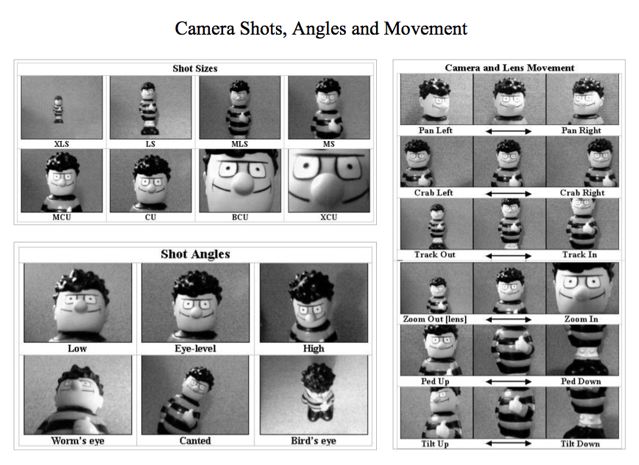
Camera shots and Angles
Different types of camera shot:
Extreme long shot:
This shot can be taken from as far as a quarter of a mile away. Because of the length away, it is usually used for setting the scene and establishing the beginning of the movie. Also, it commonly shows the outside (a landscape, the outside of house, etc.). The distance means that it will have very little detail shown in the shot.
Long shot:
Generally, this shot is the closest to 'life size' shots. Because of the size, it is easier to compare the size and shape of the objects in the shot.
Medium shot:
Usually, this contains roughly 'half' of a figure. It may be from the waist up and because of this, this shot is particularly used in scenes with dialogue. This is because it is low enough to see the persons movements and what they are doing with their hands, but is close enough to see the facial features of the person. Because of this, it enables the audience to see the emotion of the scene, and what is actually going on in the scene.
Close-up:
This shot shows very little background because it is concentrated majorly on either a face or a particular object. This shot is good for a more dramatic scene as it can effectively add emotion and focus on someone/something.
Extreme Close-up:
An extreme close up is seemingly like a magnifying glass, as it is so zoomed in. It can be used to see a certain object in particular detail.
Camera Angles:
Bird's-Eye view:
Birds-eye view is simply the view from above. It is called this as if a bird looked down, the camera angle would show what the bird would be seeing.
High Angle:
A high angle is quite a dramatic angle, as it takes the shot from above. However, it is not as high or sharp as the Birds-Eye view.
Eye Level:
Eye level is a rather ordinary shot and is taken from the 'horizon' line. It is usually used to frame a persons facial features.
Low Angle:
The low angle is similar to the eye level, however, it is slightly lowered. It can be used to increase the height of an actor, which can be helpful for those playing a role that is taller than themselves.
Oblique/Canted Angle:
This angle is tilted to the side. It can be used to suggest general imbalance, for example, if a character was drunk or falling over, this angle could be used.
Worm's-Eye:
Essentially, Worms-Eye is the opposite of Birds-eye. Rather than being taken from above, this is taken from the ground. It gives the illusion of power, as the subject towers over the camera.
You should use a selection of different shots and angles as it makes the film more engaging.
By changing the angle, it can create a particular mood- if a shot is taken using Worms-Eye, it can make a person appear intimidating, which would make the scene darker.
Also, you can use different shots to change the perspective, so that the events are perceived from a different characters point of view. This can make you sympathise for certain characters more (or in some cases, less).

Examples of effective camera shots:
Harry Potter and the Chamber of secrets:
In the opening few seconds of this film, the camera pans through clouds in the nights sky. The movie begins at an extreme long shot that is at a very high angle. It appears to be in the point of view of an owl, as the camera is 'flying' and breaks through the cloud layer. It pans across Harry's street from above and comes to rest at his house.
I think this is effective as it already 'sets the scene' for the movie- it is flying which is almost magical, which is what the movie is about.
It's kind of a funny story:
At the beginning of this scene, the main character simply says "It starts with a bridge" over a blank screen. The camera then 'turns on' and the scene begins on a long shot of a bridge. It is at a low level looking upwards towards the sky and when the focus changes, it turns into an eye level shot. The camera is moving forward, as if it was in a car or a bike. This is effective as it is in the perspective of the main character and shows the audience what they are seeing and feeling.
James Bond, Skyfall:
This scene opens on a rather normal camera angle. It is at Eye-level and the character steadily gets closer to the camera, so the shot rapidly gets closer. The picture is blurry, yet comes into focus as James gets nearer. It is effective as it obscures the character so we don't actually know who it is, until the camera becomes less blurry. We are relieved to see that he is James Bond.
What effect does shorter shot lengths have?
Shorter shot lengths are usually used in order to concentrate on a specific object or person. They can be used to portray an expression as the background is out of focus.
What effect does longer shot lengths have?
Longer shots can be used to establish a setting. It can be used to sweep over and 'set' the scene for a film. Also, they can be used to portray an interaction between characters. Moreover, it can be used to show a prolonged section of emotion in a characters face- it can create empathy for the character if we see a long shot of them crying etc.
Overall, camera angles and shots can be used to portray many different things. If used correctly, they can be used successfully to set a scene or to portray emotion.
Extreme long shot:
This shot can be taken from as far as a quarter of a mile away. Because of the length away, it is usually used for setting the scene and establishing the beginning of the movie. Also, it commonly shows the outside (a landscape, the outside of house, etc.). The distance means that it will have very little detail shown in the shot.
Long shot:
Generally, this shot is the closest to 'life size' shots. Because of the size, it is easier to compare the size and shape of the objects in the shot.
Medium shot:
Usually, this contains roughly 'half' of a figure. It may be from the waist up and because of this, this shot is particularly used in scenes with dialogue. This is because it is low enough to see the persons movements and what they are doing with their hands, but is close enough to see the facial features of the person. Because of this, it enables the audience to see the emotion of the scene, and what is actually going on in the scene.
Close-up:
This shot shows very little background because it is concentrated majorly on either a face or a particular object. This shot is good for a more dramatic scene as it can effectively add emotion and focus on someone/something.
Extreme Close-up:
An extreme close up is seemingly like a magnifying glass, as it is so zoomed in. It can be used to see a certain object in particular detail.
Camera Angles:
Bird's-Eye view:
Birds-eye view is simply the view from above. It is called this as if a bird looked down, the camera angle would show what the bird would be seeing.
High Angle:
A high angle is quite a dramatic angle, as it takes the shot from above. However, it is not as high or sharp as the Birds-Eye view.
Eye Level:
Eye level is a rather ordinary shot and is taken from the 'horizon' line. It is usually used to frame a persons facial features.
Low Angle:
The low angle is similar to the eye level, however, it is slightly lowered. It can be used to increase the height of an actor, which can be helpful for those playing a role that is taller than themselves.
Oblique/Canted Angle:
This angle is tilted to the side. It can be used to suggest general imbalance, for example, if a character was drunk or falling over, this angle could be used.
Worm's-Eye:
Essentially, Worms-Eye is the opposite of Birds-eye. Rather than being taken from above, this is taken from the ground. It gives the illusion of power, as the subject towers over the camera.
You should use a selection of different shots and angles as it makes the film more engaging.
By changing the angle, it can create a particular mood- if a shot is taken using Worms-Eye, it can make a person appear intimidating, which would make the scene darker.
Also, you can use different shots to change the perspective, so that the events are perceived from a different characters point of view. This can make you sympathise for certain characters more (or in some cases, less).
Examples of effective camera shots:
Harry Potter and the Chamber of secrets:
I think this is effective as it already 'sets the scene' for the movie- it is flying which is almost magical, which is what the movie is about.
It's kind of a funny story:
James Bond, Skyfall:
What effect does shorter shot lengths have?
Shorter shot lengths are usually used in order to concentrate on a specific object or person. They can be used to portray an expression as the background is out of focus.
What effect does longer shot lengths have?
Longer shots can be used to establish a setting. It can be used to sweep over and 'set' the scene for a film. Also, they can be used to portray an interaction between characters. Moreover, it can be used to show a prolonged section of emotion in a characters face- it can create empathy for the character if we see a long shot of them crying etc.
Overall, camera angles and shots can be used to portray many different things. If used correctly, they can be used successfully to set a scene or to portray emotion.
Tuesday, 22 November 2016
Making a story for a picture (PRACTICE)
This is stolen from Noah:)
Hello!
So today, we were told to find a random picture on the internet in the groups we intended to work in for our coursework. We did so, with no context of what we would do with the picture.
Emily and I chose a picture of a cool, angry cat staring out of a window.

After every group had chosen a picture (ours was the best/most cat), we were told to create a story which would revolve around what was in the picture, and write it in 3 sheets.
Each sheet would be a different layer of the storyline and aspects of it, e.g. sheet 1 would be the story on a basic surface level, and sheet 3 would be going right into the nooks and crannies of the storyline.
WHO? - "The Cat is a person who has been trapped in a cat. He is John Cena" <-- This is John Cena.
WHAT? - "The Cat's in front of a window"
WHEN? - "Nowadays"
WHERE? - "At his stately home in America"
WHY? - "Somebody was sick of the John Cena memes, and wanted to defeat him"
WHO? - "Dwayne 'The Rock' Johnson turned John Cena into a cat. He was sick of the memes"
WHAT? - "He is plotting revenge against Dwayne"
WHEN? - "Tomorrow"
WHERE? - "John is trapped in a kennel"
WHY? - "He is trying to escape to get his body back and defeat Dwayne"
WHO? - "Dwayne gets the abilities from Crandalf the Fabulous. He can turn John into a cat with these. If Dwayne fails, Crandalf will turn him (Dwayne) into a cat. JC and Dwayne need to team up at the end to defeat Crandalf. Dwayne is being mind controlled."
WHAT? - "He is plotting revenge against Dwayne"
WHEN? - "Tomorrow"
WHERE? - "John is trapped in a kennel"
WHY? - "He is trying to escape to get his body back and defeat Dwayne"
So... we certainly have an... interesting... story.
Emily was the main driving force of the story, so we have her to thank :D
Anyways, coursework soon coming up. Ech.
~ Noah C :D
Hello!
So today, we were told to find a random picture on the internet in the groups we intended to work in for our coursework. We did so, with no context of what we would do with the picture.
Emily and I chose a picture of a cool, angry cat staring out of a window.
After every group had chosen a picture (ours was the best/most cat), we were told to create a story which would revolve around what was in the picture, and write it in 3 sheets.
Each sheet would be a different layer of the storyline and aspects of it, e.g. sheet 1 would be the story on a basic surface level, and sheet 3 would be going right into the nooks and crannies of the storyline.
SHEET 1
WHO? - "The Cat is a person who has been trapped in a cat. He is John Cena"
<-- This is John Cena.
WHAT? - "The Cat's in front of a window"
WHEN? - "Nowadays"
WHERE? - "At his stately home in America"
WHY? - "Somebody was sick of the John Cena memes, and wanted to defeat him"
SHEET 2
WHO? - "Dwayne 'The Rock' Johnson turned John Cena into a cat. He was sick of the memes"
WHAT? - "He is plotting revenge against Dwayne"
WHEN? - "Tomorrow"
WHERE? - "John is trapped in a kennel"
WHY? - "He is trying to escape to get his body back and defeat Dwayne"
SHEET 3
WHO? - "Dwayne gets the abilities from Crandalf the Fabulous. He can turn John into a cat with these. If Dwayne fails, Crandalf will turn him (Dwayne) into a cat. JC and Dwayne need to team up at the end to defeat Crandalf. Dwayne is being mind controlled."
WHAT? - "He is plotting revenge against Dwayne"
WHEN? - "Tomorrow"
WHERE? - "John is trapped in a kennel"
WHY? - "He is trying to escape to get his body back and defeat Dwayne"
So... we certainly have an... interesting... story.
Emily was the main driving force of the story, so we have her to thank :D
Anyways, coursework soon coming up. Ech.
~ Noah C :D
Subscribe to:
Posts (Atom)